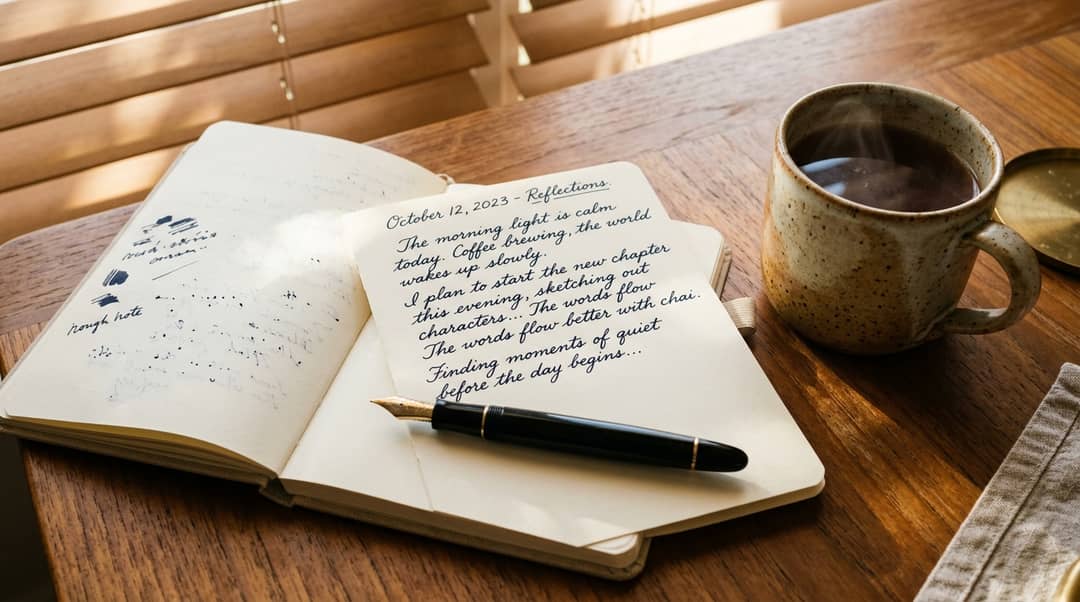
First-Person Writer POV: Morning Journal, Fountain Pen & Chai
There is a brief, tender interval of the day—perhaps sixty or seventy minutes long—where the rational architecture of the ego has not yet fully hardened into place.
You have been asleep for seven hours, wandering through the liquid, illogical geometry of dreams. Your defenses are down. You haven’t yet remembered your social obligations, your bank account balance, or the critical reviews of your last book.
If you pick up your phone during this interval, the world rushes in like cold bathwater. The spell breaks instantly.
But if you sit down at a wooden table with an uncapped pen and an unlined notebook, you have access to the raw sediment of your soul before the day sweeps it away.
This is where Morning Pages live.
The Sophomore Trap and the Inner Heckler
Eight years ago, after my debut novel found an unexpected readership in both New York and India, I was gripped by an invisible, suffocating paralysis.
Every time I sat down to draft my second manuscript, an invisible, sneering critic sat down on the shoulder of my cardigan.
Whenever I wrote a sentence—“The afternoon heat hung over the gulmohar trees like wet canvas”—the critic would lean in and whisper with cruel amusement:
I would hit the backspace key. I would rewrite the sentence five times. By eleven o’clock in the morning, my neck would be locked in painful spasms, my tea would be cold, and the blank white document on my screen would have three apologetic sentences.
I was trying to write like an immortal master on the first try. I had forgotten that every beautiful, enduring book begins as an embarrassing, sprawling, incoherent mess.
Then, an older poet friend in Bangalore told me about Julia Cameron's practice of Morning Pages: three pages of strictly longhand, unedited, stream-of-consciousness writing done immediately upon opening your eyes, before brushing your teeth or making breakfast.
Why the Pen Must Be Analog
People often ask me why I refuse to type my morning pages on a laptop. After all, I can type seventy-five words per minute on a mechanical keyboard; longhand cursive is achingly, physically slow.
When you type on a computer screen:
- Your eyes constantly scan backward, judging the syntax before the emotion has finished arriving.
- The backspace key is an open invitation to cosmetic cowardice. The second a thought feels vulnerable, you delete it and replace it with something polite and safe.
- The medium itself is sterile and uniform. Times New Roman looks the same whether you are writing about the death of your father or ordering laundry detergent.
When you write with a gold nib on unlined cotton paper:
- There is no backspace. If an ugly, petty, or terrified thought spills out of your wrist, it stays on the page. You have to look at it. You cannot pretend you didn't feel it.
- Your handwriting becomes an electrocardiogram of your emotional nervous system: sprawling and frantic when you are anxious, tiny and deliberate when you are grieving, looping and spacious when you are at peace.
- The tactile sensation of metal gliding over plant fibers—the gentle, rhythmic scratch of the nib—anchors the breath. It turns writing from an intellectual panic into a physical, meditative prayer.
The Four Seasons of a Writer's Day
A novelist's day cannot be a factory assembly line. The mind needs different atmospheric pressures for different tasks:
- The Morning Dawn (5:30 – 8:00 AM): The Subconscious Extraction. The morning pages. The messy rough drafts. No outlines, no editing, just pure emotional transmission.
- The Midday Forge (9:30 AM – 1:00 PM): The Architectural Craft. Now the critic is invited into the room. We look at pacing, sentence cadence, narrative stakes, and dialogue subtext. We cut three hundred words to make five words sing.
- The Afternoon Archive (2:30 – 5:00 PM): Receptive Reading. Walking through secondhand bookstores, reading history or poetry, sitting in the corner of a cafe listening to strangers argue about their families.
- The Dusk Incubation (5:30 – 7:00 PM): The Unplugged Walk. Moving the physical body through the city without headphones. Letting the day’s work settle into the compost of the subconscious mind.
A Parting Thought
Do not wait for the muse to descend with a trumpet. The muse is shy; she does not like crowds, and she certainly does not read group text chats.
Wake up while the city is still dreaming. Fill your fountain pen. Pour your tea.
Write three pages of complete, unvarnished nonsense. Empty the emotional basement. And watch how quickly the real story begins to bloom in the quiet space you’ve cleared.