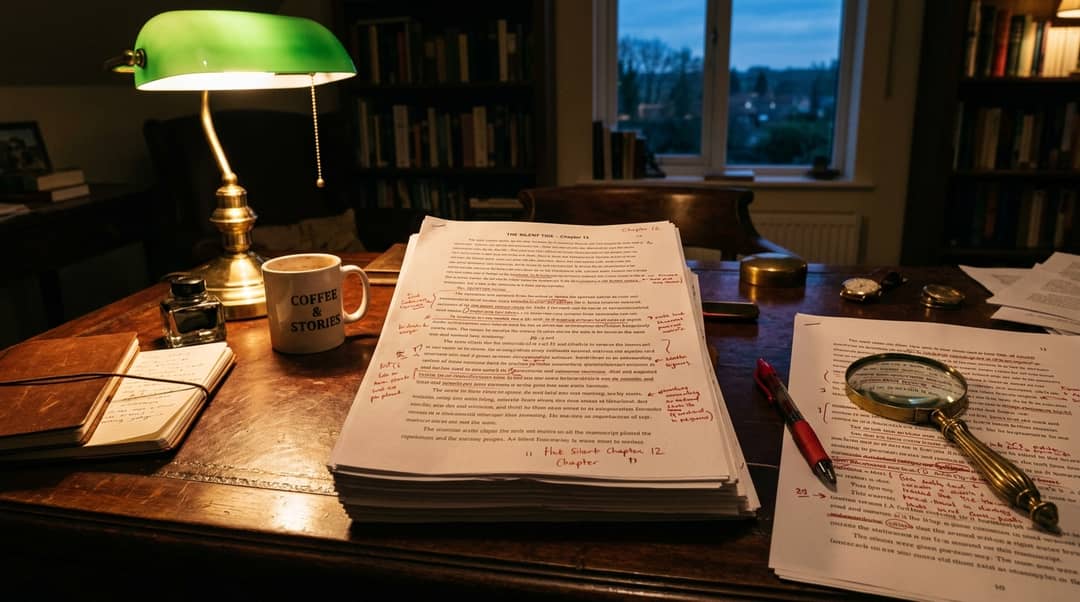
First-Person Novelist POV: Manuscript Stack, Red Pencil & Banker Lamp
The city outside is still shrouded in that heavy, pearl-gray Pacific fog that curls off the bay and blankets the Victorian rooftops. Downstairs, the street is silent except for the faint hum of a municipal street sweeper four blocks away.
My ginger cat, Ruskin, has curled himself into a tight, warm crescent on top of the manuscript draft of chapter seven. He knows, with the infallible intuition of animals, that while he is sleeping on those pages, I will not have the heart to disturb him, and therefore I will not have the opportunity to cross out another entire page of dialogue in fitful dissatisfaction.
Beside my notebook sits a steaming ceramic mug of chai, spiced with crushed green cardamom and fresh ginger sliced thin enough to see through. The green glass shade of my banker’s lamp casts a quiet emerald pool of light across the desk.
This is the threshold. This is the only hour of the day when the mind belongs entirely to itself.
The Architecture of the Descent
People who do not write fiction often assume that writing is an act of intellectual assembly—like building a stone wall or solving an algebraic equation. You sit down, open your laptop, pull a brick from the pile, apply some mortar, and lay down sentences until the timer dings.
I had to explain that descending into the emotional interiority of a grief-stricken sixty-year-old mother is not a switch you flick on and off.
It is more like scuba diving into a deep, subterranean cave.
For the first twenty minutes of sitting in silence, the surface mind is chaotic and noisy. It bobs and twitches with domestic trivialities: Did I remember to reply to that email from my accountant? Where did I leave my keys? I should buy more oat milk.
Around minute thirty, if you have the discipline not to look at your phone, the surface chatter begins to drown. The breath slows down. The pulse in your wrists settles.
And then, around minute forty-five, you slip through the thermocline. The water turns cold, dark, and still.
Suddenly, you are no longer in your apartment in San Francisco. You are standing on a dusty platform in Bangalore in 1994, smelling wet earth and kerosene, listening to the specific hesitation in a father’s voice before he boards a night train he will never return from.
You can hear the cadence of his breath. You can feel the rough fabric of his wool shawl against your hand.
And if, at minute forty-four—just as you are about to reach out and touch that memory—a smartphone vibrates on the wood beside you with a notification about a flash sale or a calendar invite, the entire cave collapses.
You are yanked violently back to the surface, gasping for air. The vision evaporates. And you cannot simply dive back down; the water is churned, muddy, and empty. You have lost not just thirty seconds of attention, but the entire morning’s descent.
Attention Residue: The Modern Curse
In her luminous essay collection Teaching a Stone to Talk, Annie Dillard wrote a line that I have taped above my drafting desk:
"How we spend our days is, of course, how we spend our lives. What we do with this hour, and that one, is what we are doing."
When you attempt to write while remaining accessible to the ambient digital slipstream of the world, you are not multi-tasking. You are suffering from what cognitive psychologists call attention residue.
Every time you glance at an unanswered text message from a cousin, a headline about a political crisis, or an editorial query about foreign publication rights, a small fragment of your consciousness stays tethered to that external emergency.
You return your eyes to the manuscript, but your soul is no longer undivided. You are writing with thirty percent of your working memory hostage to the world's anxiety.
The prose you produce in that state is defensive, thin, and brittle. It lacks music. It lacks the deep, unhurried resonance that only comes from total human surrender to the page.
The Three Sacred Boundaries
Over a decade of writing novels and essays, I have had to construct an armor of quiet around my mornings. These are not productivity hacks; they are spiritual boundaries:
- The Analog Threshold (5:00 AM – 9:00 AM): During the four sacred morning hours, my phone stays powered off inside a wooden drawer in the entryway. No email client is opened. No browser tabs exist. The outside world is welcome to burn or flourish without my consultation until the clock strikes nine.
- The Physical Friction of the Nib: I draft my rough scenes longhand with a fountain pen—a Pilot Custom 823 with a fine gold nib filled with Iroshizuku blue-black ink—on unlined Japanese paper. A keyboard allows you to type faster than your soul can feel. The physical resistance of ink flowing across cotton forces the hand to match the pace of human heartbeat.
- The Banishing of the Inner Censor: You cannot draft and edit at the same moment without strangling the work in its cradle. In the morning, you must give yourself permission to write terribly, clumsily, sentimentally. The editorial scalpel belongs to the afternoon; the morning belongs to the wild, imperfect child.
A Note for the Reader
If you have a book inside you, a poem, an essay, or simply a memory you are desperate to preserve before time carries it away, do not wait for a sabbatical in Tuscany or a cabin in the woods.
Reclaim your quiet hours right where you are.
Wake up forty-five minutes before your household stirs. Light a candle. Boil the kettle. Leave the screen dark. Step across the threshold into silence, and let the real words find you.