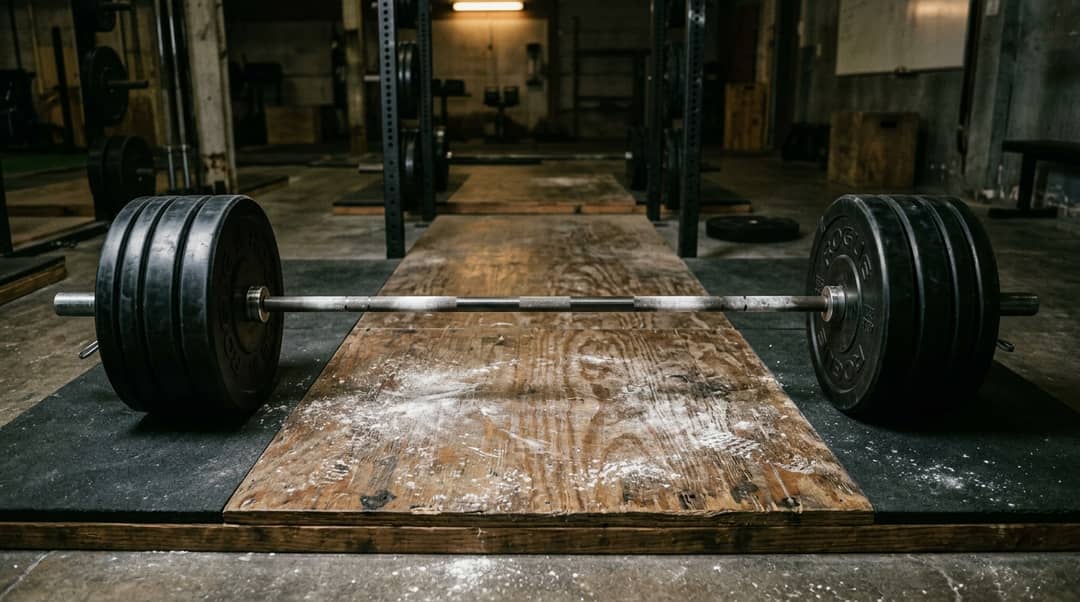
First-Person Athlete POV: Chalked Barbell on Lifting Platform
Last Tuesday around 7:15 AM, I was lying flat on my back on the rubber floor of my gym in the Presidio.
My shirt was soaked, my hands were coated in white chalk, and my hamstrings were actively drafting a formal cease-and-desist letter to my brain. I had just finished my final working set of heavy back squats—five sets of three at 405 pounds.
One of my newer coaching clients, Dave, walked over, shook his shaker bottle with that frantic gym-bro enthusiasm, and looked at the whiteboard.
"Hey Cole," he said, pointing at the afternoon block. "Is that a misprint? You’ve got a nine-mile trail run on Mount Tam scheduled for 4:30 PM today."
"Not a misprint, Dave," I said, peeling myself off the floor.
Dave looked at me like I had just informed him I eat dry drywall for breakfast. "Bro. Aren’t you terrified of the interference effect? You're gonna burn off your quads! Cardio steals your gains!"
I had to laugh. "Dave, my friend, if easy cardio murdered muscle tissue that quickly, the postal service would be entirely staffed by ghosts."
The Ghost of Robert Hickson (1980)
Every time someone warns you that running will shrink your biceps, they are unwittingly quoting a 1980 study by an exercise physiologist named Robert Hickson.
Now, Hickson was a pioneer, but his experimental protocol was essentially legalized human torture:
- He took non-athletes.
- He had them lift heavy weights five days a week.
- And he made them run hard intervals six days a week on the exact same days.
After six weeks, his subjects' strength gains plateaued and reversed. Hickson published his findings, declared "The Interference Effect," and kicked off forty years of gym-bro hysteria where grown men refused to climb two flights of stairs out of fear their glutes would evaporate.
Here’s what Hickson actually proved: if you crush an untrained human being with zero recovery, terrible nutrition, and suicidal volume, they break down. Shocking science!
The Molecular Tug-of-War: mTOR vs. AMPK (In Plain English)
Look, I love the biochemistry, but let’s skip the twelve-syllable textbook jargon and look at what’s actually happening inside your muscle cells when you train:
- The Construction Crew (mTORC1): When you rip a heavy deadlift off the floor, mechanical tension fires up a master cellular switch called mTOR. Think of mTOR as a loud, caffeinated construction foreman who screams: "Stack more bricks! We need thicker muscle fibers yesterday!" That’s muscle protein synthesis.
- The Efficiency Inspector (AMPK): Five hours later, when you head out for a 60-minute aerobic jog, your cells deplete glycogen and your AMP-to-ATP ratio climbs. This activates AMPK. AMPK is the city building inspector who walks onto the job site with a clipboard, checks the budget, and says: "Hold up. Fuel is tight. We can’t afford to build a massive skyscraper right now; build more solar panels (mitochondria) instead."
And here’s the kicker: AMPK phosphorylates a protein called TSC2, which acts like an emergency brake on mTOR.
If you squat heavy and immediately sprint out the gym door for a 45-minute tempo run, the building inspector slaps the hard hat out of the foreman’s hands. Your muscle-building signal gets slashed by nearly half.
The 6-Hour Golden Rule: How We Hack the System
The good news? This biological interference isn't permanent—it’s purely a matter of timing.
- mTOR signaling peaks between 45 minutes and 3 hours post-lift, then locks into its steady construction phase.
- AMPK phosphorylation spikes during cardio but drops back to baseline within roughly 2 to 3 hours after you finish sweating.
So how do you deadlift 500 pounds and still run a 3:15 marathon? You separate the stimuli:
- Morning (07:00 AM): Heavy Strength Work. Maximum neural recruitment. Squat, press, pull. Send the loud mTOR signal.
- The Buffer (08:30 AM – 03:30 PM): Eat 50 grams of quality protein. Smash a massive bowl of rice. Drink water. Go to work. Let the construction crew work uninterrupted.
- Late Afternoon (04:30 PM): Zone 2 Aerobic Base. Hop on the Concept2 rower, stationary bike, or a flat trail. Keep the intensity low (nasal breathing only!). AMPK does its mitochondrial magic without stomping on your morning lifting gains.
The 3 Hybrid Commandments I Live By
Over a decade of coaching athletes and competing in mountain ultras while staying over 195 pounds, these are the rules carved in stone on my gym wall:
- Cardio Must Not Beat You Up: 70% of your aerobic base should be low-impact. The bike, the skierg, the rower, the incline treadmill walk. Running is high-impact eccentric pounding; if you run 50 miles a week on pavement, your knees won't have the cartilage left to squat. Save the impact for your key trail days.
- You Cannot Diet Like a Fitness Model: If you are training twice a day, your daily caloric expenditure will blow past 3,500 calories easily. If you try to do that on low-carb keto or dry chicken breasts with steamed broccoli, you will crash your thyroid and end up with the hormonal profile of a Victorian chimney sweep. Eat your potatoes. Eat your rice. Respect the glycogen ledger!
- Check Your Ego at the Trailhead: When the calendar says "Zone 2 easy flush," that means conversational pace. If you start racing strangers up the hill because your ego couldn't handle getting passed by an 62-year-old birdwatcher with binoculars, you just sabotaged tomorrow's deadlift session.
The Tailgate Wrap-Up
Building a body that can haul a 200-pound sandbag and run a half-marathon in the woods isn't a genetic miracle. It’s just honest physiology, smart recovery, and showing up when you don't feel like it.
Don't let the internet tell you that you have to choose between being strong and being capable.
Lift heavy things. Run through the trees. Eat a proper dinner with people you love. And if anyone tells you that cardio is stealing your gains, offer to race them up a flight of stairs and see who runs out of oxygen first.