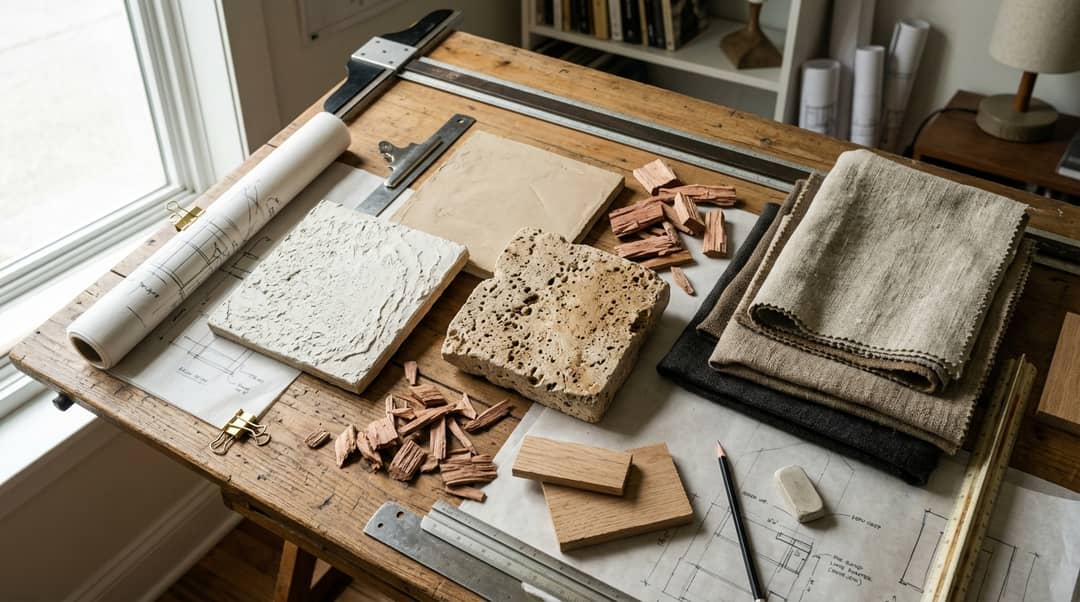
First-Person Spatial Designer POV: Travertine, Plaster & Linen Drafting Table
Walk into almost any developer-built condominium, modern corporate office, or suburban home built in the last thirty years, and close your eyes.
Run your fingertips across the wall. It feels like painted cardboard: flat, featureless, synthetic gypsum board coated in plastic latex paint.
Touch the kitchen counter. It is engineered quartz resin polished to an unnatural, oily sheen.
Step onto the floor with bare feet. It is luxury vinyl plank—literally polyvinyl chloride plastic printed with an imitation photographic pattern of oak grain.
Our modern built environment has become tactilely sterile. We have created an architectural world designed exclusively to look clean in two-dimensional digital photographs, while completely starving the human body's largest sensory organ: the skin.
Material Classification | Micro-Surface Texture | Nervous System Response |
|---|---|---|
Synthetic / Sterile Materials<br>(Plastic laminate, drywall, printed vinyl) | Uniform friction coefficient; zero organic micro-topography. | Low C-tactile stimulation; brain perceives environment as synthetic, triggering low-grade vigilance. |
Raw Tactile Materials<br>(Porous travertine, lime plaster, heavy linen, oak) | Rich organic micro-relief; natural thermal conductivity variance. | Stimulates low-threshold mechanoreceptors; promotes parasympathetic grounding and lowered salivary cortisol. |
1. The Neuroscience of Haptic Sensory Deprivation
Your skin contains over five million sensory receptors, including specialized C-tactile afferent fibers that respond specifically to gentle, textured touch.
When human beings evolved, our physical environment was rich with tactile variance: rough tree bark, weathered river stones, unspun wool, woven flax, and cool earthen clay. Our sensory nervous system relies on this tactile feedback to calibrate our sense of physical reality and safety.
When you spend sixteen hours a day touching frictionless glass screens and sitting in rooms constructed entirely of synthetic drywall and plastic laminate:
- Sensory Monotony: The lack of haptic feedback creates a low-grade cognitive restlessness known as tactile deprivation.
- Elevated Baseline Cortisol: Studies in biophilic architecture show that touching natural, porous surfaces (untreated wood, raw stone) significantly lowers salivary cortisol and reduces sympathetic nerve activity compared to synthetic counterparts.
2. The 4 Essential Tactile Materials for Modern Sanctuaries
In our architectural studio, we ban synthetic laminates and vinyl veneers. We design spaces using four honest, living materials:
Material | Physical Texture | Biological Resonance |
|---|---|---|
Hand-Troweled Lime Plaster | Micro-crystalline porosity with subtle trowel marks and velvet hand. | Absorbs and softens ambient sound; reflects light with soft matte diffusions rather than harsh glare. |
Unfilled Roman Travertine | Open sedimentary cavities, weathered matte surface, cool thermal mass. | Connects human touch to deep geological time; beautiful tactile grounding under hand and foot. |
Raw Slubbed Belgian Linen |
3. How to Introduce Tactile Architecture into an Existing Space
You do not need to gut-renovate your home to reclaim tactile health:
- Replace Synthetic Curtains with Heavy Slubbed Linen: Swap polyester drapes for 400gsm unbleached linen. When the afternoon breeze moves them, the room breathes.
- Introduce One Raw Stone Anchor: A single unpolished travertine dish or rough limestone bookend on your desk gives your fingers an anchor between typing sessions.
- Lime-Wash One Wall: Use natural Roman lime wash on your bedroom wall. The slight mineral roughness catches evening candlelight with an ethereal, living texture.
💡 Tip Never choose materials that pretend to be something else. No faux-marble tiles, no printed wood vinyl. A modest pine plank with real knots has infinitely more dignity than five hundred dollars of fake quartz.
The Takeaway
Architecture is not a picture to be looked at on Instagram.
Architecture is a sheltering skin that touches your skin. Choose materials that age gracefully, wear honestly, and remind your body that you belong to the living earth.