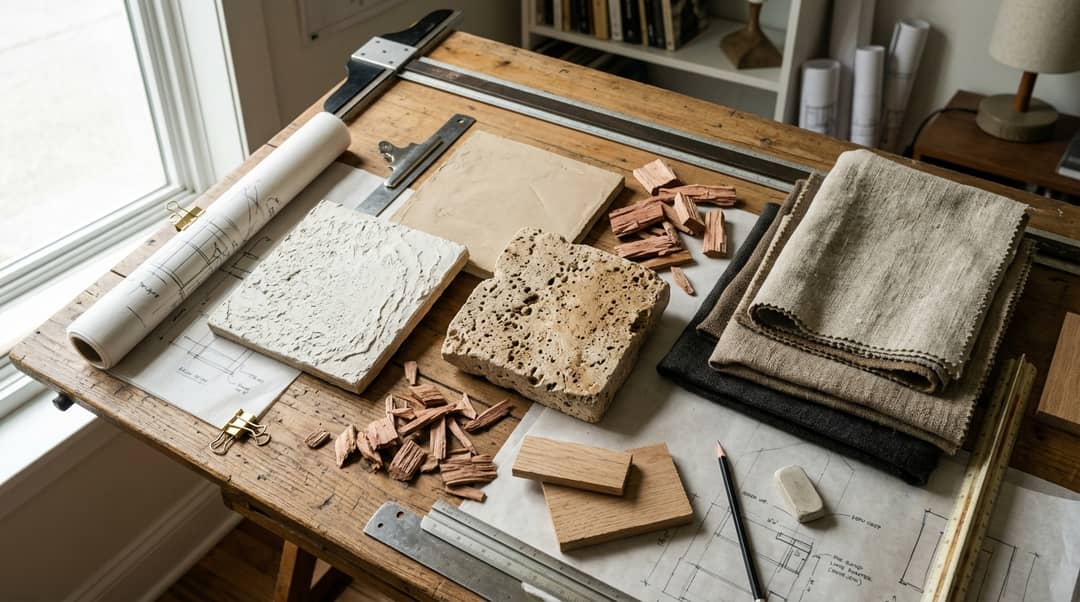
First-Person Architectural POV: Rough Plaster & Natural Stone
Whenever I am invited into a newly completed luxury home designed by a conventional commercial firm, I am struck by an eerie, visceral sensation:
Every surface is slick, glossy, synthetic, and cold. The kitchen counters are polished quartz composite that looks like plastic. The cabinet fronts are seamless acrylic laminates. The floors are engineered vinyl planks printed with a photograph of oak grain, sealed beneath a polyurethane film.
You run your fingertips across the wall, and your nervous system receives nothing. Zero friction. Zero temperature variance. Zero texture.
Your eyes tell your brain that you are in a luxurious living room.
But your fingertips—which contain thousands of specialized mechanoreceptors honed over millions of years of mammalian evolution—send a very different message:
We have engineered the tactile soul out of our living spaces, and we wonder why so many people feel chronically ungrounded, anxious, and dissociated inside their own homes.
The Neuroscience of Haptic Grounding
In Finnish architect Juhani Pallasmaa’s seminal work, The Eyes of the Skin, he issued a warning that every contemporary designer should tattoo on their forearm:
"The eye wants to collaborate with the other senses. All the senses, including vision, are extensions of the tactile sense; the senses are specialized skins."
When you touch a surface with your bare hand, your skin doesn’t just register touch. Four distinct classes of mechanoreceptors fire simultaneously:
- Meissner’s Corpuscles: Detect delicate changes in low-frequency friction.
- Merkel Discs: Register steady, fine-grained surface curvature and edges.
- Pacinian Corpuscles: Sense deep tactile vibration.
- Ruffini Endings: Respond to lateral skin stretch and warmth.
When your palm touches a piece of hand-hewn, unsealed white oak, these receptors transmit a symphony of sensory data to the somatosensory cortex.
The brain recognizes the authentic variation of organic cellular growth: the cool dip of the earlywood grain, the dry warmth of natural cellulose, the subtle microscopic tooth of the wood fiber.
Clinical neurobiology shows that authentic tactile interaction with natural, irregular materials triggers parasympathetic vagal activation. Heart rate variability increases, breathing slows down, and salivary cortisol levels measurably decrease.
Natural texture is not a decorative luxury; it is neurological grounding medicine.
The Four Living Textures of a Sanctuary
In my architectural studio, we build sanctuaries out of four ancient, breathable elements:
1. Mineral Lime Plaster (Tadelakt / Venetian Lime)
Gypsum drywall coated in synthetic latex paint creates a suffocating plastic skin on interior walls.
We replace it with traditional slaked-lime plaster troweled by hand. Lime cures through carbonation—literally absorbing carbon dioxide from the air as it hardens into limestone over decades.
It is cool to the touch, diffuses sunlight with a velvety, chalky softness, and carries the faint, microscopic ripple of the craftsman’s trowel.
2. Raw, Honed Travertine and Sandstone
Never polish interior stone to a high-gloss mirror finish. High-gloss stone looks like an airport lobby.
Choose stone that has been honed with water or split along its natural geological bed. Walk on it with bare feet. Let your soles feel the ancient sediment of riverbeds and sea floors.
3. Unsealed, Oil-Finished Hardwood
Throw away the polyurethane floor sealers that trap wood under a sheet of liquid plastic. Treat natural oak, Douglas fir, or larch with pure linseed oil and beeswax.
The wood continues to breathe, absorbing humidity in the summer and releasing it in the winter. And as your family walks on it over decades, it develops a deep, golden patina of life.
4. Heavy, Unbleached Belgian Linen
Synthetic polyester drapery creates static electricity and collects dust. Heavy, unbleached linen has a substantial, sculptural weight that moves gracefully in a breeze, softening the acoustic reverberation of a room into a hushed library quiet.
From the Drafting Table
A home is not an art gallery meant to be viewed from behind velvet ropes. A home is a tactile embrace meant to hold your tired body at the end of an exhausting day.
Bring rough, living materials into your space. Run your palms across raw stone and honest timber.
Let the textures of the earth remind your nervous system that you are safe, that you are grounded, and that you are home.