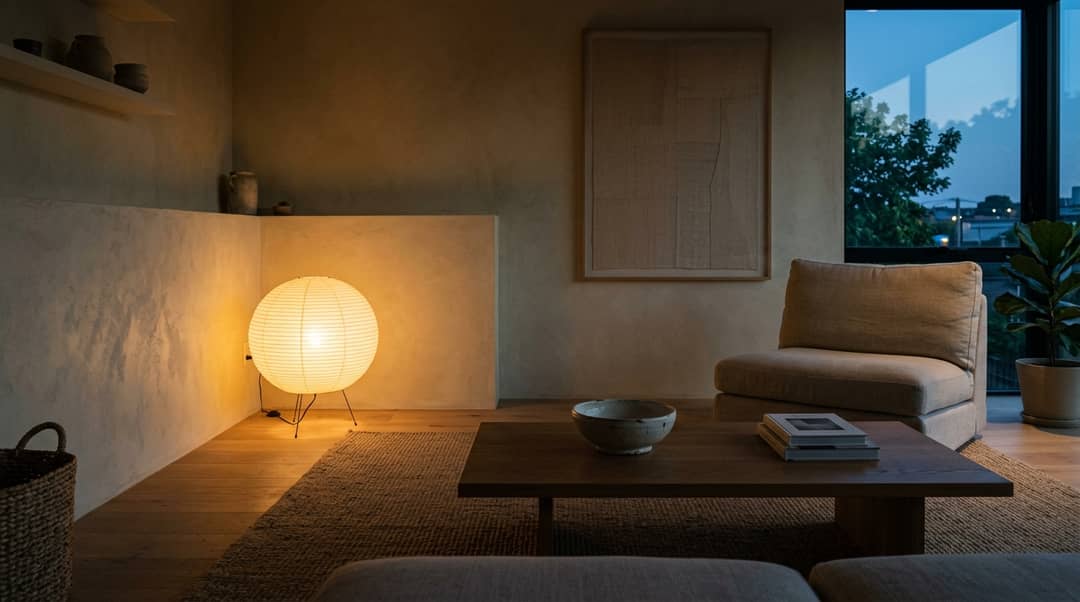
First-Person Architectural POV: Low-Level Ambient Ceramic Lamps
In Sweden, we have a quiet cultural horror that has recently found its name across the internet: The Big Light.
You know the fixture I mean. It is the solitary glass orb or chrome disc mounted dead center in the middle of a ceiling.
At 8:30 in the evening, someone walks into the living room, flips the wall switch, and instantly floods the entire room with five thousand lumens of cold, unshaded, 4000K glare.
Suddenly, a room meant for rest and conversation looks like an operating theater where someone is about to undergo an emergency appendectomy.
Every shadow is obliterated. Every facial feature is flattened into a harsh, clinical grimace. And somewhere in your midbrain, an ancient evolutionary alarm bell begins to clang:
Turning on The Big Light after sunset is not an aesthetic mistake. It is a biological crime against your nervous system.
The Evolutionary Neurobiology of Firelight
For roughly two hundred thousand years, the human species obeyed an immutable optical law:
- During the Day: Bright, blue-wavelength sunlight ($5,000\text{K} - 6,500\text{K}$) streamed from high above the horizon, penetrating the sky, stimulating melanopsin-containing retinal ganglion cells in the lower half of the human eye. This signaled the suprachiasmatic nucleus to pump cortisol, suppress melatonin, and demand wakefulness.
- At Twilight: The sun sank below the horizon. High-angle illumination disappeared entirely. For the final four hours of the waking day, our ancestors gathered around a campfire.
Consider the physical properties of campfire light:
- Low Angle: The light originates from the ground or below eye-level, casting long, soft, protective shadows.
- Warm Color Temperature: The spectral peak of burning wood rests between 1,800K and 2,200K—a rich, deep amber that contains virtually zero blue wavelengths.
- Gentle Luminance: It illuminates the faces of your tribe without illuminating the entire forest.
When you illuminate an evening room from the ceiling with bright white LEDs, you are lying to your biology. You are demanding that your nervous system produce daytime stress hormones while you are trying to wind down for sleep.
The 4-Point Pool Protocol (How I Light a Sanctuary)
In my architectural commissions from Stockholm to coastal California, I implement one absolute rule in residential projects:
Instead, we construct an ecosystem of low-level, layered light pools:
1. Eye-Level and Below
Every light source after sunset must reside below sixty inches (1.5 meters) from the floor. Floor lamps tucked beside linen armchairs, table lamps on low credenzas, and concealed baseboard runners. When light enters the eye from below the horizon, it does not trigger the daytime melanopsin response.
2. The 2200K Amber Standard
Replace your standard 3000K or 4000K hardware-store bulbs with 2200K warm amber LED filaments or dim-to-warm fixtures. When illuminated, the light should look like honey, aged whiskey, or late-October candlelight.
3. Diffuse Through Natural Organic Fibers
A bare bulb is visual violence. Screen your light sources through tactile, organic materials:
- Washi paper (such as Isamu Noguchi’s Akari light sculptures).
- Heavy unbleached linen or raw silk shades.
- Matte ceramic or turned-wood sconces that bounce illumination softly against lime-washed plaster walls.
4. The Island of Shadow
A room without shadows is a room without mystery or safety. We do not light entire rooms; we light destinations.
A warm pool of amber light over a reading chair. A gentle glow over a bowl of persimmons on a kitchen island. A soft reflection in a corner mirror.
The surrounding shadows are not emptiness; they are the calm negative space that allows the mind to relax.
From the Drafting Table
Tonight, when the sun dips below your city’s horizon, do not touch the wall switch.
Leave the Big Light dead in the ceiling.
Switch on a low table lamp with a paper shade. Light a beeswax candle. Watch how your breathing deepens, how your shoulders fall away from your ears, and how your living room transforms from a sterile cage into a warm, protective sanctuary.